
Heavy Equipment Hauling
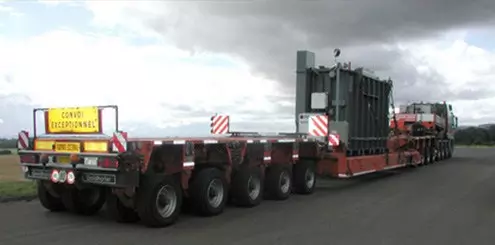
Choosing the correct logistics solution for your heavy machinery can be a challenge, particularly when they require specialist handling. The selection of trailer, on which construction equipment will ride, is key before preparing it for transport. You should remember that standard flatbeds measure five feet above the ground. The total clearance on most UK roads is 16 feet 6 inches, which implies that you need to calculate the trailer height, plus the equipment height.
This Construction Equipment Hauling guide was created to help you to plan for successful transportation. Projector Lifting Service Ltd have over 159 years of experience in heavy machinery lifting and relocation. We can help you plan the safe and efficient moving of your plant vehicles. Our range of lifting equipment and expertise means that we can move anything from generators, transformers and injection moulding machine to Crematoria and Euro shuttle. Contact us with the details at the end of the page to get a quotation for a bespoke contract lifting service or heavy lifting between 20-453 Tonnes.
Follow the link below to read more about our heavy equipment hauling services.
Avoid Wide Load Designation
Pieces of large construction equipment are considered 'wide loads' during transport. Oversized machinery includes cranes, dozers, graders, scrapers, excavators and off-road dump trucks.
You must ensure that all construction machinery meet the required dimensional regulations; such as removing attachments of certain machinery to ensure compliance with regulations. It is more economical and efficient for attachments to be shipped as separate entities; otherwise, it would be considered an oversized load.
Prepare Your Equipment for Transport
Read the manual of the equipment to obtain specific guidelines on how to make it ideal for transport. Identify delicate parts which require additional protection during transportation; this includes items such as knobs, levers or gauges. The knowledge about the vehicle and its load is essential for heavy hauliers to control vehicle weight and load distribution.
Tips for preparing your construction equipment for transport include:
- Prevent unwanted debris by covering it before transport
- As a precaution, disconnect the batteries, so they don't get drained
- Request photos of the transport to show that all the safety equipment has been used
- Wash the machine before transport as dirt and debris can obscure handholds and tie-down points
- Doors may open in the wind and cause damage if they're not closed properly
- If your equipment is travelling as an oversize load, you'll need lights, signs and safety banners. Your transportation agent should provide these.
The Empty Weight of the Vehicle
Before loading any equipment onto a transport vehicle, you should first establish the weight of the load, the weight capacity of the vehicle and the load configuration. This will help you comply with different sizes and weight requirements for transporting heavy loads.
The weight distribution is managed well by the flatbed and step deck trailers because they have spread tandem axle or triaxle sets.
The tandems allow hauliers to carry more weight over two axles because of the ability to spread over 10 feet apart (20,000 pounds per axle for a total 40,000 pounds instead of 34,000 pounds on the tandem set). You will handle 42,000 pounds when triaxle set is used.
You should slide the tandem towards the problem side on a trailer if it has sliding tandems. If the front of the trailer is heavier, sliding the axle forward is essential. Considering the load weight and the point of the load on the trailer, every "hole" will cause a change in the balance by around 200 pounds. The shift in balance will happen between the drive axles and the trailer axles. When you slide the fifth wheel, the fulcrum will be located to the drive axles, near trailer nose. There will be a transfer of weight loaded at the trailer front between the drive axles and steer axle on sliding the fifth wheel.
Flat Bed Trailers/Step Deck Trailers
Haul transporters are used to move large and heavy pieces of equipment or dense items with awkward shapes. This process takes place using flatbed and step deck trailers. If a load is dense or heavy, a person could find it challenging to position it onto the trailer. The general rule is the heaviest part of a load should be placed near the trailer's centre, but not towards the trailer front.
The requirements of cargo securement should be taken into account when loading a flatbed trailer. You will need extra securement if the load's weight is placed in the middle or near the trailer's rear, instead of against the headboard. Seeking the guidance of securement requirements in your location is prudent. The heavy vehicles, equipment and machinery, will require chains to secure them because of their durability and strength. If you are near the maximum gross weight required, fuel weight will cause a difference. The weight of diesel is 8 pounds per gallon.